Table of Contents
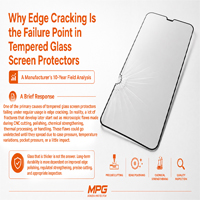
Why Edge Cracking Is the Failure Point in Tempered Glass Screen Protectors
A Manufacturer’s 10-Year Field Analysis
A Brief Response
One of the primary causes of tempered glass screen protectors failing under regular usage is edge cracking. In reality, a lot of fractures that develop later start out as microscopic flaws made during CNC cutting, polishing, chemical strengthening, thermal processing, or handling. These flaws could go undetected until they spread due to case pressure, temperature variations, pocket pressure, or a little impact.
Glass that is thicker is not the answer. Long-term durability is more dependent on improved edge polishing, regulated strengthening, precise cutting, and appropriate inspection.
1. What Does Edge Cracking Mean?
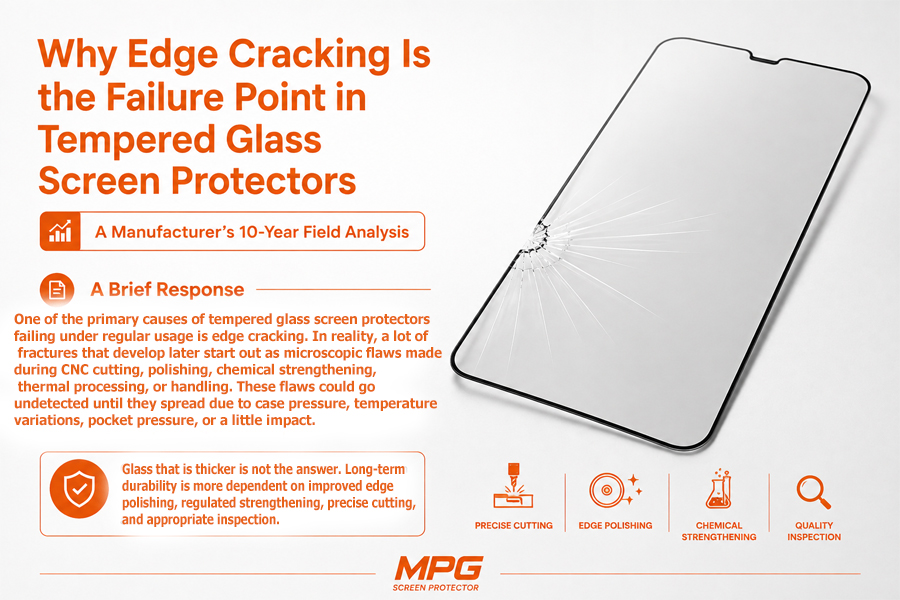
When a fracture begins at the glass’s edge, chamfer, or corner and progresses inside, it is known as edge cracking.
Occasionally these founded mostly:
- Micro-chips: The Microscopic glass pieces are sometimes only visible under magnification and are absent from the edge. Small fractures that extend inward from the edge are known as hairline cracks.
- Spider-web cracks are several cracks that propagate from one damaged location following pressure or impact.
- Even a tiny flaw might eventually develop into a significant problem. Because of this, certain protectors seem to “crack by themselves” even in the absence of a significant impact.
2. What Makes the Edges More Dangerous?
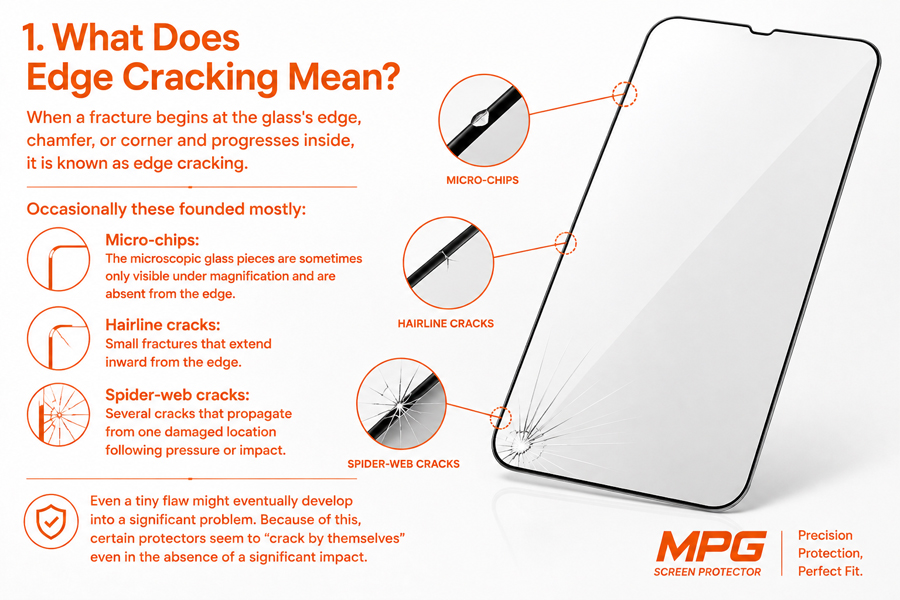
Glass strength is increased via chemical strengthening, which produces a layer of compressive stress on the surface. This reinforced layer may usually go several micrometers thick for thin glass, like a 0.33 mm panel.
Nevertheless, the primary glass surface is always more protected than the cut edge. A microcrack caused by cutting may turn into a weak spot.
This explains why a screen protector could withstand a direct blow to the center yet break when pressure gets to a damaged edge.
3. Five Principal Reasons for Edge Cracking
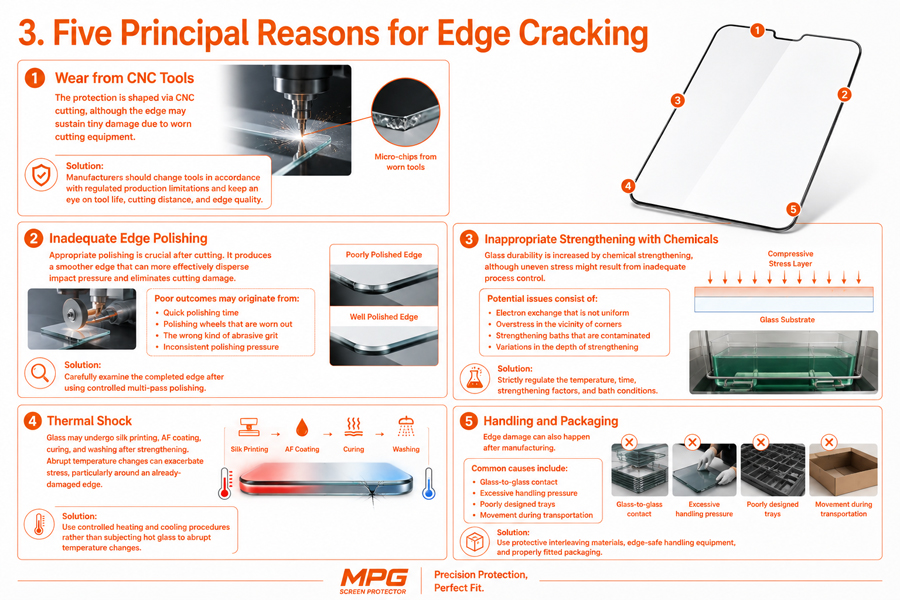
1. Wear from CNC Tools
The protection is shaped via CNC cutting, although the edge may sustain tiny damage due to worn cutting equipment.
Solution: Manufacturers should change tools in accordance with regulated production limitations and keep an eye on tool life, cutting distance, and edge quality.
2. Inadequate Edge Polishing
Appropriate polishing is crucial after cutting. It produces a smoother edge that can more effectively disperse impact pressure and eliminates cutting damage.
Poor outcomes may originate from:
- Quick polishing time
- Polishing wheels that are worn out
- The wrong kind of abrasive grit
- Inconsistent polishing pressure
Solution: Carefully examine the completed edge after using controlled multi-pass polishing.
3. Inappropriate Strengthening with Chemicals
Glass durability is increased by chemical strengthening, although uneven stress might result from inadequate process control.
Potential issues consist of:
- Electron exchange that is not uniform
- Overstress in the vicinity of corners
- Strengthening baths that are contaminated
- Variations in the depth of strengthening
Solution: Strictly regulate the temperature, time, strengthening factors, and bath conditions.
4. Thermal Shock
Glass may undergo silk printing, AF coating, curing, and washing after strengthening. Abrupt temperature changes can exacerbate stress, particularly around an already-damaged edge.
Solution: is to use controlled heating and cooling procedures rather than subjecting hot glass to abrupt temperature changes.
5. Handling and Packaging
Edge damage can also happen after manufacturing.
Common causes include:
- Glass-to-glass contact
- Excessive handling pressure
- Poorly designed trays
- Movement during transportation
Solution: Use protective interleaving materials, edge-safe handling equipment, and properly fitted packaging.
4. How Should Edge Quality Be Tested?
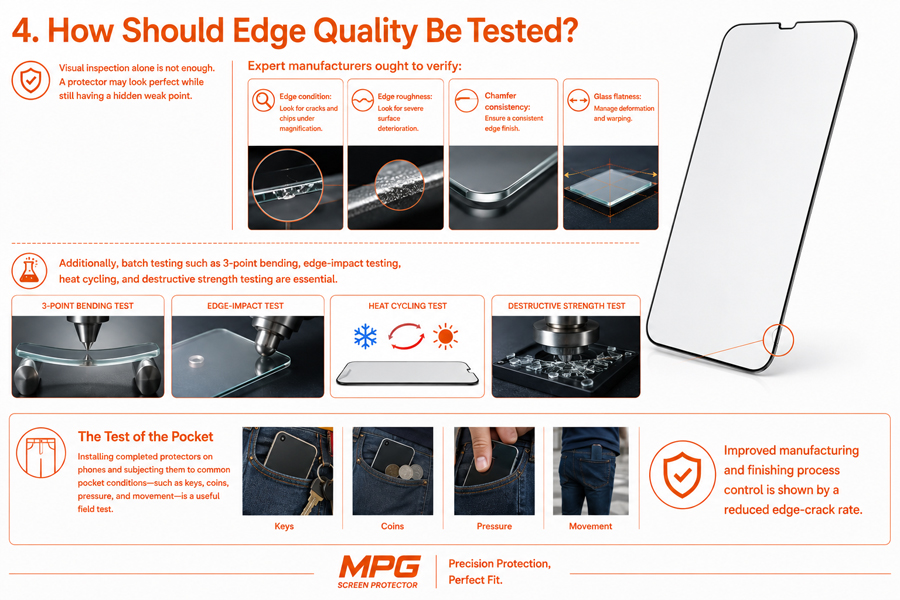
Visual inspection alone is not enough. A protector may look perfect while still having a hidden weak point.
Expert manufacturers ought to verify:
- Edge condition: Look for cracks and chips under magnification.
- Edge roughness: Look for severe surface deterioration.
- Chamfer consistency: Ensure a consistent edge finish.
- Glass flatness: Manage deformation and warping.
Additionally, 3-point bending, edge-impact testing, heat cycling, and destructive strength testing are examples of batch testing.
The Test of the Pocket
Installing completed protectors on phones and subjecting them to common pocket conditions—such as keys, coins, pressure, and movement—is a useful field test.
Improved manufacturing and finishing process control is shown by a reduced edge-crack rate.
5. What Is a Better Edge Treatment?
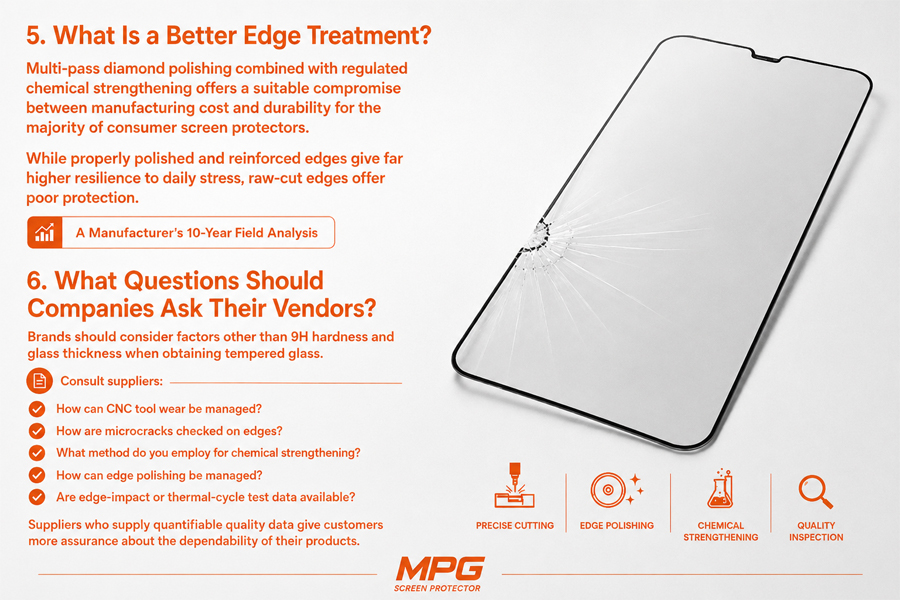
Multi-pass diamond polishing combined with regulated chemical strengthening offers a suitable compromise between manufacturing cost and durability for the majority of consumer screen protectors.
While properly polished and reinforced edges give far higher resilience to daily stress, raw-cut edges offer poor protection.
6. What Questions Should Companies Ask Their Vendors?
Brands should consider factors other than 9H hardness and glass thickness when obtaining tempered glass.
Consult suppliers:
- How can CNC tool wear be managed?
- How are microcracks checked on edges?
- What method do you employ for chemical strengthening?
- How can edge polishing be managed?
- Are edge-impact or thermal-cycle test data available?
Suppliers who supply quantifiable quality data give customers more assurance about the dependability of their products.
7. Frequently Held Myths Regarding Edge Cracking
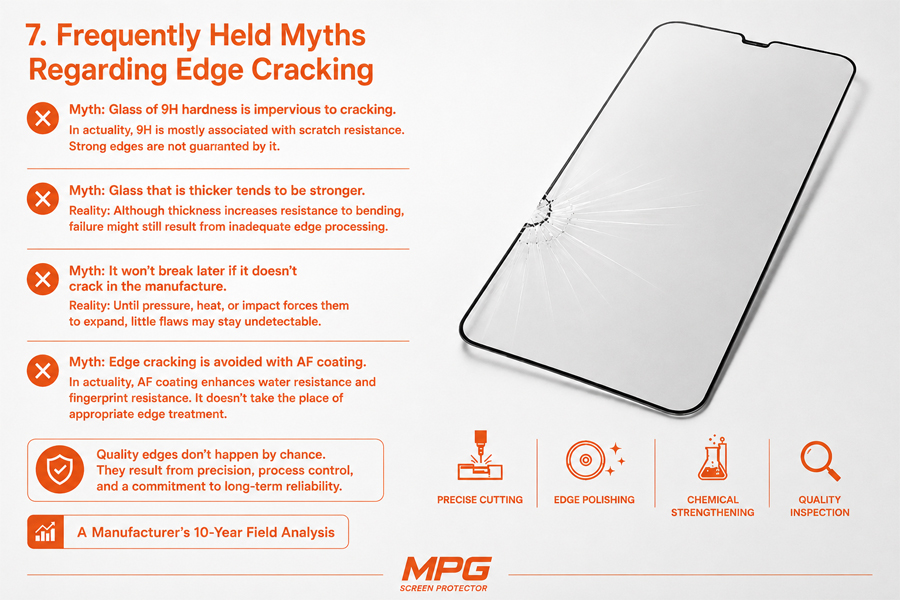
Myth: Glass of 9H hardness is impervious to cracking.
In actuality, 9H is mostly associated with scratch resistance. Strong edges are not guaranted by it.
Myth: Glass that is thicker tends to be stronger.
Reality: Although thickness increases resistance to bending, failure might still result from inadequate edge processing.
Myth: It won’t break later if it doesn’t crack in the manufacture.
Reality: Until pressure, heat, or impact forces them to expand, little flaws may stay undetectable.
Myth: Edge cracking is avoided with AF coating.
In actuality, AF coating enhances water resistance and fingerprint resistance. It doesn’t take the place of appropriate edge treatment.
8. The Conclusion
- Cutting, polishing, chemical strengthening, thermal processing, handling, and packaging—rather than only glass thickness—are typically linked to edge cracking.
- Manufacturers can lower returns, warranty claims, and customer complaints with improved edge control. For brands, measuring and assessing edge quality are just as crucial as determining hardness and thickness.
For MPG Screen Protector to provide dependable tempered glass screen protectors for OEM and ODM clients worldwide, precise processing and quality control are crucial.
Also please visit our new product: